
Sunscreen in the Lowcountry: What to Look For, From a Mount Pleasant Pharmacist

Key takeaways:
→ Look for the words broad spectrum and SPF 30 or higher. Broad spectrum matters more than the number.
→ Most people apply far less than the amount sunscreen is tested at, which lowers the protection they actually get.
→ Mineral and chemical filters both work. The best sunscreen is the one you will reapply.
→ Several common medications make skin burn faster, and most people are never told.
→ In the Lowcountry the UV index reaches its highest levels from May through August and stays elevated into October, so sun protection is not only a summer habit.
In this guide:
What SPF actually measures
Why broad spectrum matters more than the number
Mineral and chemical filters
How much to use, and how often
Medications that make skin more sun-sensitive
Sun care for babies and children
Why living on the coast changes the math
Frequently asked questions
Around here, sun exposure is not a summer problem. It is a Tuesday problem. Between the beaches, the boats, the golf, and the school pickup line, most of us are outside year-round, and the UV in the Lowcountry stays meaningful long after the tourists have gone home.
That is usually when the questions start at our counter. Which SPF is high enough? Is mineral better? Is the expensive one actually doing more? And the one almost nobody thinks to ask, which is whether the prescription they picked up ten minutes ago has just made their skin far more likely to burn.
What SPF actually measures
SPF measures one thing: protection from UVB, the rays that cause sunburn. It does not measure protection from UVA, the rays associated with premature aging and longer-term skin damage. That is the most common misunderstanding on the shelf, and it is why the number alone is not enough.
The number is also less dramatic than it looks. SPF 15 filters roughly 93 percent of UVB. SPF 30 filters about 97 percent. SPF 50 reaches about 98 percent. Moving from 30 to 50 adds about a percentage point, not double the protection. The American Academy of Dermatology recommends SPF 30 or higher for everyday use, and there is little practical reason to chase far beyond 50 as long as you apply enough and reapply on schedule.
Why broad spectrum matters more than the numberis
If you read only one phrase on the bottle, make it broad spectrum.
Broad spectrum means the product has been tested to protect against both UVA and UVB. Under FDA labeling rules, only a broad spectrum product with SPF 15 or higher may be described as helping reduce the risk of skin cancer and early skin aging, and only when used as directed alongside other sun protection measures. A product that is not broad spectrum can claim to help prevent sunburn, and nothing more.
A few words you will not find on a compliant label, because the FDA does not permit them: sunblock, waterproof, and sweatproof. No sunscreen blocks all UV, and none is truly waterproof. What you will see instead is water resistant for 40 minutes or water resistant for 80 minutes, which tells you how long the tested protection holds while swimming or sweating. It does not mean all day.
Mineral and chemical filters
Both work. They just work differently.
Mineral sunscreens use zinc oxide or titanium dioxide. They sit on the surface of the skin and deflect UV, they start working on contact, and they tend to be gentler, which is why they are often the first suggestion for babies, young children, and reactive skin. The trade-off is the white cast, though newer formulations have improved a great deal.
Chemical sunscreens use filters such as avobenzone, octocrylene, and homosalate. They absorb UV and convert it to heat. They tend to feel lighter, spread more easily, and sit better under makeup. They need about fifteen minutes to become effective.
One point worth knowing, because patients ask: in 2019 the FDA proposed that only zinc oxide and titanium dioxide currently meet its standard for generally recognized as safe and effective, and requested more safety data on the other commonly used filters. That is a request for data, not a finding of harm, and dermatology groups continue to recommend sunscreen use broadly. If it concerns you, mineral is a straightforward answer.
How They Work
Mineral sunscreen (made with ingredients like zinc oxide and titanium dioxide) sits on the surface of your skin and deflects UV rays before they can cause damage.
Chemical sunscreen (made with ingredients like avobenzone and others) absorbs UV rays and converts them into heat, which is then released from the skin.
When Protection Starts
Mineral sunscreen begins working immediately after application, making it a convenient option if you're heading outside right away.
Chemical sunscreen needs about 15 minutes to fully absorb before it provides effective protection, so it's best to apply it before going outdoors.
How They Feel on Your Skin
Mineral formulas are typically thicker and may leave a white cast, especially on darker skin tones.
Chemical sunscreens tend to feel lighter, spread more easily, and blend into the skin without leaving visible residue.
Who They're Often Recommended For
Mineral sunscreen is commonly recommended for babies, children, and people with sensitive or reactive skin because its active ingredients remain on the skin's surface.
Chemical sunscreen is often preferred for everyday wear, especially under makeup, and many people with darker skin tones appreciate its transparent finish.
Reapplication
No matter which type you choose, both mineral and chemical sunscreens should be reapplied every two hours, or more often if you're swimming, sweating, or towel drying.
How much to use, and how often
This is the part almost everyone gets wrong, and it undoes more sun protection than any product choice.
The SPF on the bottle is measured in a laboratory using a specific quantity of product. Most people apply a quarter to half of that amount, which means the protection they actually receive is well below the number they paid for.
A practical guide: about one ounce, roughly a shot glass, covers the whole body. For the face and neck, about half a teaspoon, or the two-finger method, which is a line of sunscreen along the length of your index and middle fingers.
On timing: apply chemical sunscreen about fifteen minutes before going out, mineral works immediately, and both need reapplying every two hours, and straight after swimming, heavy sweating, or toweling off. A generous first application with no second one is not a plan.
Medications that make skin more sun-sensitive
Iron supports both immune function and healthy growth, and deficiency is common, but more is not better. Iron is one of the nutrients kids most often run low on, especially during growth spurts, and low iron can affect immunity and energy. At the same time, too much iron is genuinely dangerous for children, which is why a separate iron supplement should only be used when a blood test confirms low levels and a clinician recommends it. Many children’s multivitamins are made without iron for exactly this reason. If you are unsure whether your child needs it, this is a good question for your pharmacist or pediatrician.
The categories that come up most often at our counter:
Certain antibiotics, including tetracyclines such as doxycycline, the fluoroquinolones, and sulfonamides
Some diuretics, particularly hydrochlorothiazide
Retinoids, both oral and topical
Certain nonsteroidal anti-inflammatory drugs
Some antidepressants and antipsychotics
Amiodarone and certain other cardiac medications
Methotrexate and some other immunosuppressants
This is not a complete list, and taking one of these does not mean staying indoors. It means sun protection has to be more deliberate: broad spectrum, reapplied on schedule, plus shade, a hat, and UV-protective clothing where you can.
If you are not sure whether something you take belongs on that list, bring your medication list to the counter and ask. It takes a minute, and it is exactly the kind of question we are here for.
Sun care for babies and children
For infants under six months, the guidance is shade and clothing first. The American Academy of Pediatrics advises keeping babies out of direct sun and using hats and lightweight long sleeves, with a small amount of sunscreen on exposed areas such as the face and the backs of the hands only when shade and clothing are not practical.
From six months onward, sunscreen is appropriate. Mineral formulas are often the easier choice for young skin, and stick formats are useful on faces because they are less likely to run into eyes.
The habit matters more than the product. Sunburns in childhood are associated with higher lifetime skin cancer risk, and the routine built now is the one a child will carry.
Why living on the coast changes the math
Three things make the Lowcountry different from a general sunscreen guide.
The UV here is genuinely extreme, and for longer. Charleston reaches the top of the UV index scale from roughly May through August, and stays at elevated levels from spring into October. Even in the middle of winter the index does not fall to nothing. A guide written for a northern state simply does not describe the conditions outside your door.
Water and sand reflect UV back at you, so a day on the boat or at Sullivan's Island delivers more exposure than the same hours spent in a backyard.
Clouds are not protection. A meaningful share of UV passes straight through cloud cover, and overcast beach days are behind some of the worst sunburns we hear about.
That is why our pharmacists treat sunscreen as a year-round item rather than a seasonal one, and why September is not the month to put it away.
What we carry, and how to choose
We keep our sun care shelf simple, with two lines we trust: Sun Bum and Supergoop.
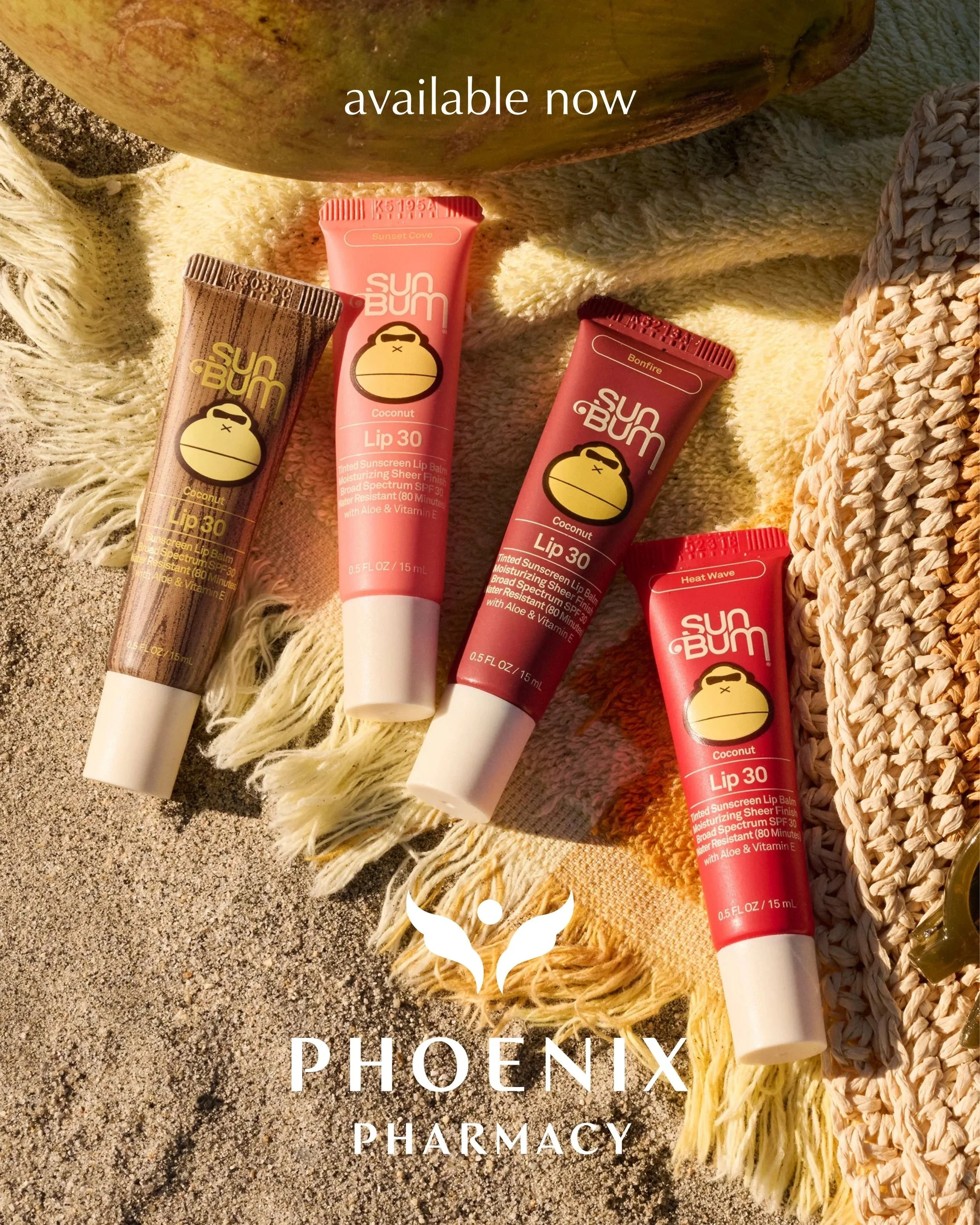
Sun Bum is the easy, everyday choice, and the one most families reach for. We carry it across the range: Original lotions in SPF 15 and SPF 30, Face lotions in SPF 30 and SPF 50, SPF 30 sprays, a mineral option, and the after-sun cool-down gels and lip care for when you have caught a little too much. Reef-friendly and gentle enough for regular use.
Supergoop is the more refined line, built around daily facial wear. The Everyday lotion runs from SPF 30 to SPF 50 in a few sizes, with lightweight body and face options that sit well under makeup and skip the heavy finish. If sunscreen is part of your morning routine rather than just a beach-day item, start here.

Either way, the rules from the rest of this guide still apply: broad spectrum, enough of it, and reapplied through the day. Come in and we will help you match one to your skin and your routine.
A pharmacist’s note on safety:
Sunscreen is the last line of defense, not the only one. Shade, a hat, and UV-protective clothing do work that no bottle can, and the hours around midday are when the UV here is strongest. Watch for changes in a mole or a spot that will not heal, and have anything new or changing looked at rather than waiting. If you burn easily, burn despite sunscreen, or take a medication that raises your sensitivity, say so at the counter. We would rather have the conversation than have you guess.
Talk to our pharmacists
Sun care is one of those things that seems simple until you are standing in front of forty bottles. Stop by or give us a call, and we will help you find something you will actually use, check whether anything on your medication list raises the stakes, and answer the questions the label does not.
Frequently Asked Questions
-
Broad spectrum SPF 30 or higher covers most everyday use. Higher numbers add very little: SPF 30 filters about 97 percent of UVB and SPF 50 about 98 percent. Applying enough and reapplying every two hours matters far more than the number on the bottle.
-
Neither is universally better. Mineral filters sit on the skin, work immediately, and tend to suit sensitive skin and young children. Chemical filters feel lighter and spread more easily. The best one is the one you will reapply without thinking about it.
-
About one ounce, roughly a shot glass, for the whole body. For face and neck, about half a teaspoon, or a line along two fingers. Most people apply far less than this, which is why they get less protection than the label suggests.
-
Yes. A significant share of UV passes through cloud cover, and overcast beach days cause more sunburns than people expect. If you will be outside for a stretch, apply regardless of what the sky is doing.
-
It can. Several common medications increase sun sensitivity, including certain antibiotics, diuretics, retinoids, and anti-inflammatories. If you are not sure about yours, bring your medication list to the pharmacy and ask. It takes a minute.
-
In the Lowcountry, yes. UV levels stay elevated well past summer and never drop to nothing, and daily incidental exposure adds up. Sun protection is better treated as a year-round habit here than as a seasonal one.
-
The AAP advises shade and clothing for infants under six months, with a small amount of sunscreen on exposed skin only when shade is not available. From six months onward sunscreen is appropriate, and mineral formulas are often gentler on young skin.
-
Yes. Sunscreen is required to stay effective for three years, and most bottles carry an expiration date. If yours has changed color or texture, or you cannot remember buying it, replace it. An expired bottle is not doing the job you think it is.
-
Usually not by much. Moving from SPF 30 to SPF 50 adds roughly one percentage point of UVB filtering. Spending on a formula you like enough to apply generously will protect you better than a higher number you use sparingly.
This article was written by the Phoenix Pharmacy team and medically reviewed by Chad Straughan, PharmD, owner of Phoenix Pharmacy and a licensed pharmacist in South Carolina. Phoenix Pharmacy is an independent compounding pharmacy serving families in Mount Pleasant and the greater Charleston area.
Last reviewed: August 2026.
This article is for general educational purposes and is not medical advice. Sunscreen is a regulated over-the-counter drug, and no sunscreen blocks all ultraviolet radiation or prevents skin cancer on its own. Sun protection works best combined with shade, clothing, and avoiding peak sun. Always talk with your pharmacist, physician, or dermatologist about your own skin, your medications, and any concerning changes to a mole or lesion.